Why Open Models Need a Consortium: The Economics and Politics of Keeping AI Open
Open-weight models power startups, research, and national AI strategies, yet the labs that build them capture almost none of that value. As frontier training costs climb, this piece explains why open models can't keep running on corporate goodwill, how a consortium could fund them like shared infrastructure, what Nvidia's Nemotron Coalition and the ATOM Project signal, and why coordination might still fail.

.jpeg)
Why Open Models Need a Consortium: The Economics and Politics of Keeping AI Open
For the past few years, “open” has been one of the most reassuring words in AI. Open-weight AI models gave startups a cheaper alternative to paid APIs, let researchers actually inspect what they were studying, and gave governments a way to build AI capability without going through a handful of Silicon Valley companies. But openness in AI has always rested on a fragile foundation as it requires the willingness of individual, profit-driven companies to keep giving their best work away.
As frontier AI models become more expensive to build and more strategically valuable to keep behind an API, the companies that have historically supported the open ecosystem are facing growing pressure to pull back. Nathan Lambert, who writes the Interconnects AI newsletter, argues that open models are too important to depend on a single company's goodwill. The only durable path forward is a shared funding structure – an AI consortium.
That isn't a comfortable conclusion for everyone. Lambert himself has been outspoken in his assertion that consortia are slow and historically prone to failure. But the alternative is open models surviving purely on the marketing budgets and strategic whims of a few labs, and this looks even more unstable. Here's why the economics and the politics of AI are pushing toward a consortium model, what that could look like, and why it might still not work.
The open-model problem
Open-weight models create huge value for the broader ecosystem, but capture very little of it directly. The full set of beneficiaries includes:
- Startups that fine-tune a model into a product
- Researchers who study model behavior directly
- Governments that deploy open models to reduce dependence on foreign resources
- Developers who get free access to capable models
- Enterprises hedging against vendor lock-in
- Cloud providers selling the compute that runs inference
- Chip makers that profit from rising demand for training hardware
The value flows to the users: the startup that fine-tunes an open model into a product, the researcher who studies model behavior, or the government that aims to avoid dependence on foreign resources.
Who benefits from open-source AI
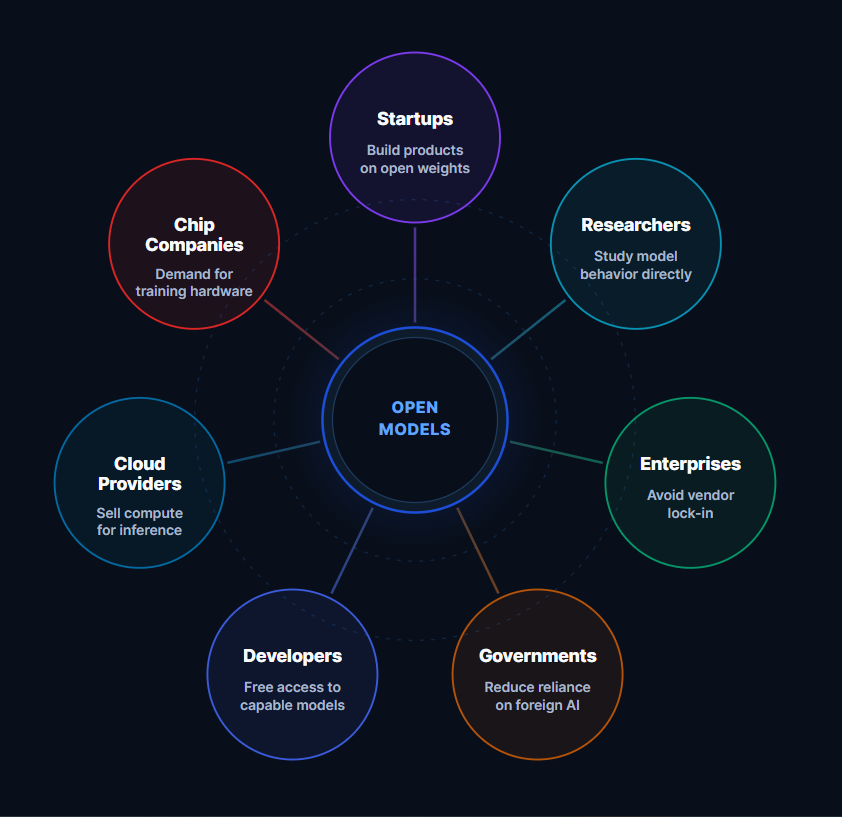
None of these benefits are returned to the original model's trainer in a way that would fund the next one. Society’s dependence on open models increases as the incentive structure supporting them weakens, making the system fragile.
The commercial logic within frontier labs points in the opposite direction. The more capable a model becomes, the more valuable it is to keep that capability behind a metered API. This creates a paradox: society needs open, inspectable, autonomous AI, but at the same time, it becomes harder to justify funding it.
To understand this contradiction, we must go beyond a simple analysis of model performance. Open and closed models handle control, safety, competition, innovation, dependency, and geopolitics in fundamentally different ways.
Open models vs closed models: Key Risks
Open model usage varies significantly across releases, and its distribution follows the long-tail pattern. On platforms like Hugging Face, a small number of models receive the vast majority of downloads. As a result, most new open-source models face a barrier to widespread distribution, regardless of their technical quality.
The other defining characteristic of the current landscape is what Nathan Lambert describes as a state of “perpetual catch-up.” Open-weight models typically lag the absolute frontier of closed models by roughly 6–9 months. This gap shifts depending on the rate of closed-model innovation cycles and the ability of open ecosystems to release similar features under constrained budgets.
In 2024, this gap seemed to narrow briefly. Open-source releases became more competitive, and some models approached parity in tasks such as following instructions, using tools, and small logical reasoning tests. But the introduction of more advanced reasoning systems and next-generation frontier models widened the gap again.
No single company can carry the burden alone
Near-frontier open models use the same training and deployment stack as leading proprietary systems. Their training requires massive computing clusters, highly skilled technical specialists, extensive curated datasets, and complex post-processing pipelines. All of this demands significant investment in security assessment and deployment infrastructure. Each stage adds cost and complexity and shifts who actually captures the value the model creates:
Open-model value chain
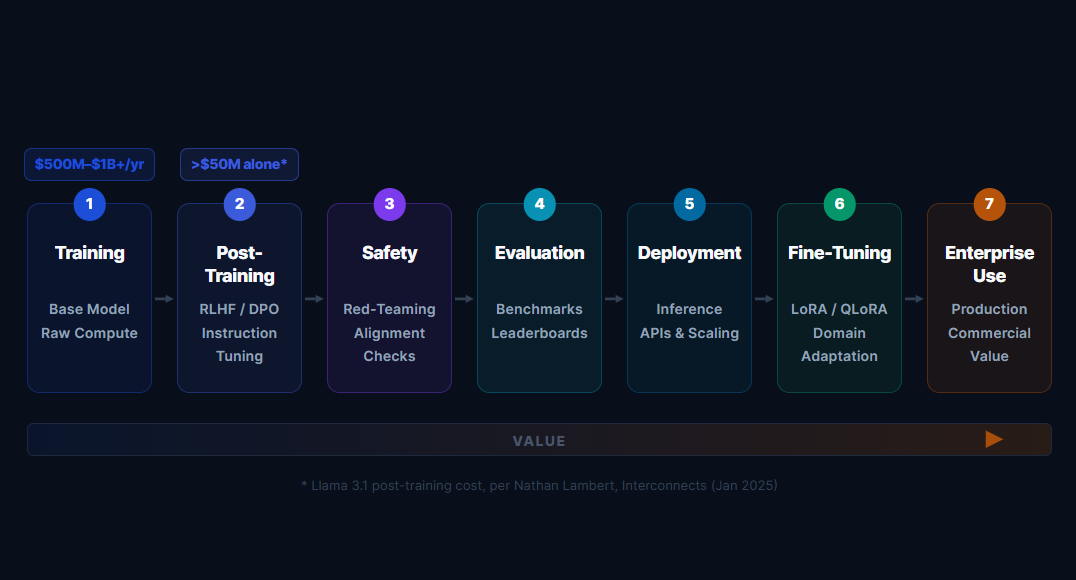
Only a limited set of organizations can realistically contribute at this level: Meta's Llama, Alibaba's Qwen, DeepSeek, Moonshot AI's Kimi models, MiniMax, Zhipu AI's GLM models, Nvidia's Nemotron series, and AI2's OLMo. But none of them create open models for the same reasons, and these incentives can change as technologies and markets evolve.
An open release can be strategically useful for a company in the short term. It builds developer mindshare, attracts talent, and signals technical credibility. But long-term competition at the frontier rewards proprietary advantage. This tension is reflected in recent history: Meta has cooled on the idea of Llama as a flagship open-source project, and staff turnover at labs like Qwen and AI2 has rocked open-source ecosystems. The likely outcome is a future full of decent small open models, and very few of them are genuinely competitive at the frontier.
Nathan Lambert frames the ecosystem: as models approach the frontier, the coordination cost rises faster than any single actor's willingness to bear it. The result is not a lack of capable players, but a lack of sustained incentive to maintain frontier-quality openness over time.
Even when multiple organizations are capable of contributing, the system does not naturally converge toward shared investment. As training costs rise and ecosystem dependence increases, direct revenue from open access remains near zero. This highlights a funding gap that no laboratory has the incentive to address.
The open-model funding gap
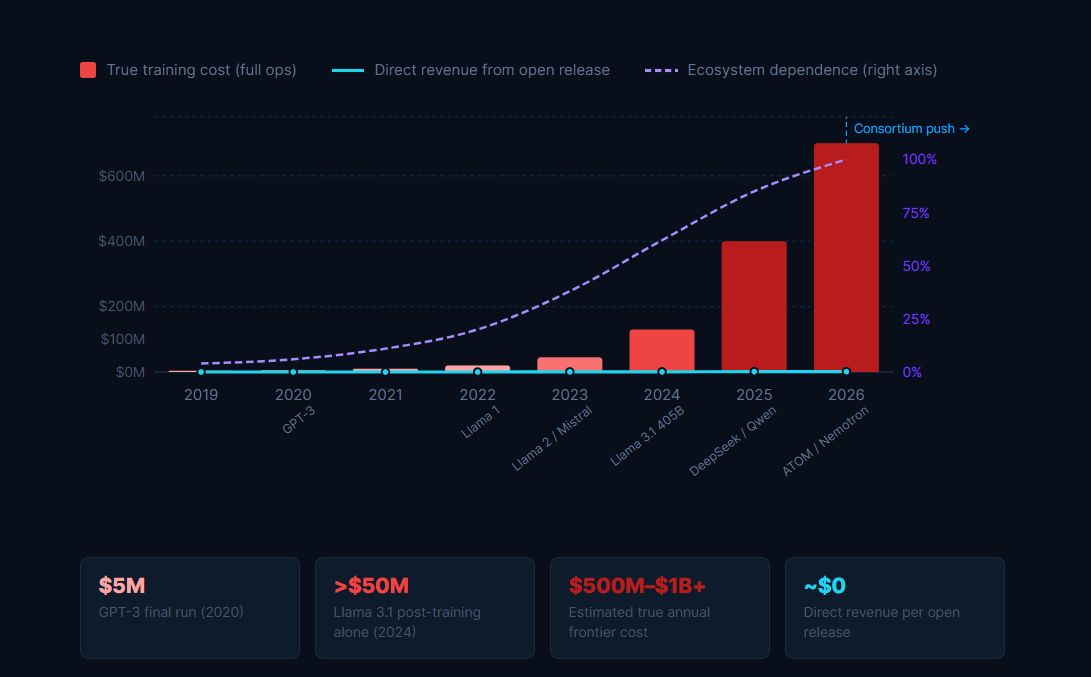
Each lab optimizes for its own product roadmap, regulatory exposure, competitive positioning, and compute budget constraints. This leads to fragmentation. Over time, it risks splitting the field into a handful of frontier closed systems and a large, uneven pack of open models that never quite catch up.
The core limitation is that no single company can afford to fund open models at the highest level while also racing to build the best one. So if individual companies cannot consistently sustain this role, what kind of system can?
A consortium is the most reasonable solution on the table. Let's break down what will actually change when the job of funding open models moves from a single company to a consortium.
Single-company model vs. Open consortium model
The economics of open-source AI: treat it like infrastructure
We are in the process of transitioning to a more suitable model for open-source software. In the traditional open source paradigm, motivated volunteers and corporate sponsors support projects indefinitely with quite modest budgets. The movement must move closer to physical infrastructure. Many parties rely on it, and it requires stable, ongoing capital to maintain.
The main economic argument for a consortium is that no single company has an incentive to spend hundreds of millions of dollars on a solo frontier training run on behalf of the entire ecosystem. Still, the same company may be ready to contribute a fraction of that cost in exchange for something more durable:
- Guaranteed long-term access,
- Influence over what gets built (model sizes, languages, domain focus),
- Freedom from dependence on one closed API provider's pricing and roadmap decisions.
If you think back, infrastructure has historically been funded by spreading the cost of a public good across many beneficiaries. The examples include research consortia in physics and the development of common standards in telecommunications. The same principle could apply to open models.
There's already a real-world test case for this. In March 2026, Nvidia launched the Nemotron Coalition to co-develop open frontier models using Nvidia's DGX Cloud compute. It brought together Mistral AI, Black Forest Labs, Cursor, LangChain, Perplexity, Reflection AI, Sarvam, and Thinking Machines Lab. Later, it was joined by Naver, H Company, Nous Research, and Prime Intellect. Mistral and Nvidia jointly built the base model; Cursor supplies coding benchmarks; LangChain provides agentic tool-use evaluation, and Prime Intellect adds reinforcement-learning environments for post-training. It's a working example of the structure Lambert has been describing – distributed contribution, shared compute, and a model that no single member could have justified building alone.
This is a geopolitical competition now
The politics of open-source AI have moved well past benchmarks and market share. China's open-model strategy, pursued through Alibaba's Qwen, DeepSeek, Moonshot, MiniMax, and Zhipu AI platforms, has led to significant global adoption. That momentum has been enough to provoke a direct political response in the United States. Here's how that played out over the past few years:
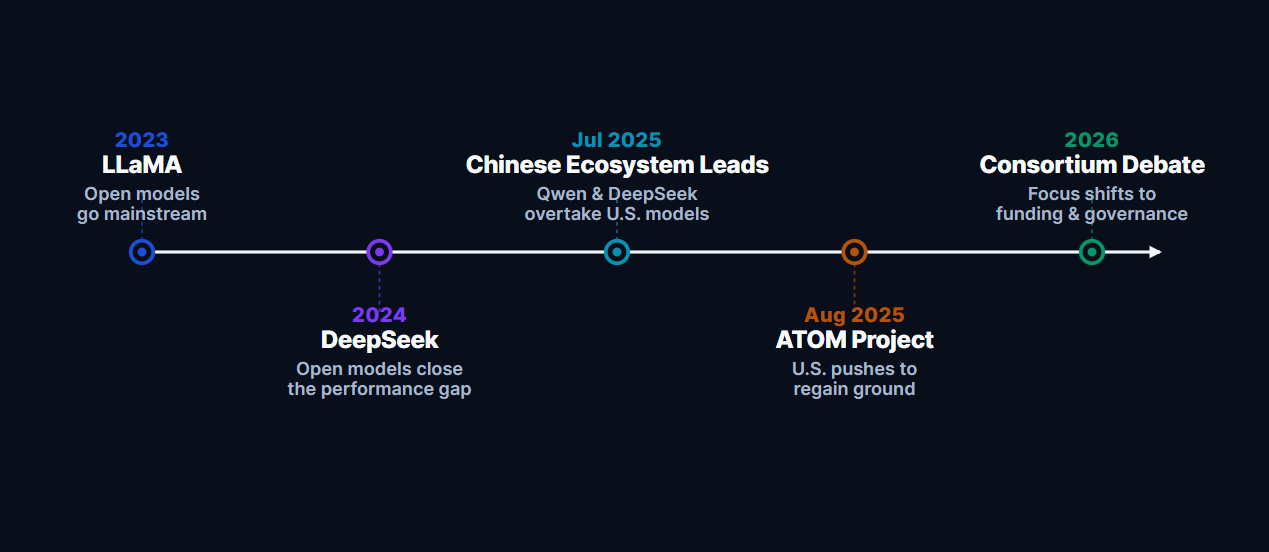
Nathan Lambert argues that frontier leadership alone is no longer enough. Without a competitive open-model ecosystem, the U.S. risks losing influence over the future direction of AI. Lambert’s ATOM Project (“American Truly Open Models”), launched in mid-2025, calls for U.S.-based compute clusters dedicated to building genuinely open-source AI. The project gained public support from figures across AI and academia. The argument has only grown stronger since then: without at least one open frontier-class model, research, low-resource-language work, and academic access all suffer.
The strategic question is no longer just who builds the best model, but who controls the ecosystem everyone else builds on. A few things are at stake:
- Who controls the AI infrastructure everyone depends on?
- Is the country secure and resilient enough?
- Can researchers study and evaluate models independently?
- Does it help or hurt innovation across the ecosystem?
- Does it keep the country's options open long-term?
None of these questions has a clean answer yet. But they're exactly what a consortium would need to get right.
What an open-model consortium could look like
A working consortium would likely draw members from across the AI industry:
- Cloud and chip providers, like Nvidia, that are looking to secure a stake in the ecosystem they supply,
- AI startups and labs seeking shared infrastructure instead of solo risk,
- Enterprises hedging against reliance on closed APIs,
- Universities and research labs that need models they can actually verify,
- Government agencies focused on sovereignty and security.
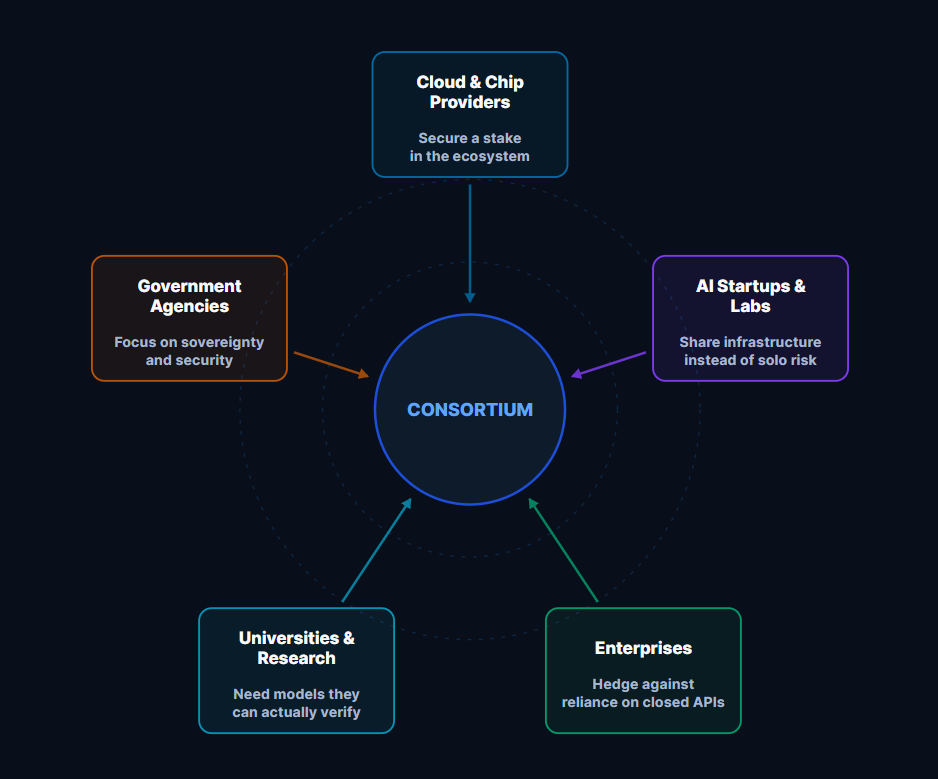
A consortium's output goes beyond a single model release. It includes the model weights, training recipes, and data pipelines that enable others to replicate or extend the work. It also includes evaluation tooling, safety research, post-training methods, and a family of smaller specialized models built on the shared base. This is the same multi-layered contribution model that the Nemotron Coalition is testing in practice.
The hard part in building such a consortium is governance. A functioning consortium needs agreed mechanisms for shared funding and rules about what gets released and under what license. It also needs a clear safety review process and a technical steering body to resolve disagreements. None of this is solved by goodwill; it requires a focused institutional approach. Standards bodies, research consortia, and some open-source foundations have used this same approach to keep shared infrastructure running for decades. On top of the shared base, members remain free to build proprietary tools, fine-tune models, and develop commercial applications. That's what keeps the incentive to participate alive in the first place.
Why a consortium might not work
Coordinating a consortium is harder than running a single lab. Members can disagree on what the model should optimize for, when to release it, what licensing to allow, and how strict the safety review should be.
Shared incentives don't hold on their own. Everyone wants the open ecosystem to survive, but the same companies are still competing commercially. Once the shared model exists, each member has a reason to quietly build proprietary advantages on top of it instead of funding the next release. Governance has to plan for that from the start; it can't assume goodwill will carry the group indefinitely.
Building a great model isn't something you can cleanly split across a committee. It takes tight, integrated calls across data, architecture, compute, infrastructure, and post-training, made by people with full context and the authority to just decide. A single motivated team is usually better at that than eight companies trying to agree. That’s why a consortium will almost certainly move more slowly than a focused lab racing for the frontier.
That trade-off might be worth it. A consortium doesn't have to beat the closed labs to matter. It just needs to stay reliable, open, and easy to build on – good enough to keep pressure on the frontier, support independent research, and stop the ecosystem from depending on just a few companies.
Conclusion
Open frontier models still lack a sustainable way to pay for themselves. For years, the ecosystem ran on a narrow set of incentives: leading labs found it strategically valuable to release powerful models. That balance is shifting. As frontier training gets more expensive, so does the cost of keeping a model open.
A sustainable alternative isn't easy to build. The most promising option so far is a consortium, but it comes with real drawbacks. Competitors have to agree on governance, safety standards, licensing, and release timing while still chasing their own commercial interests. Frontier AI development also needs fast, tightly coordinated execution, which is hard to get from a committee.
Still, the conversation has moved. Nvidia's Nemotron Coalition is already testing collaborative funding in practice. The ATOM Project reflects a similar belief: open models are now a matter of national competitiveness. Both projects are early, and neither is guaranteed to work. But the shift underneath is real.
As the technology gets more expensive and political, open models are starting to look less like a product and more like shared infrastructure. The real question switches from whether open models should exist to how to fund them for the long run. A consortium can't promise that open models will beat the closed labs. What it can do is keep the open AI ecosystem alive, competitive, and transparent enough that AI doesn't end up controlled by a handful of companies.
The Propagated.ai team consists of AI researchers, marketers and product strategists dedicated to helping companies create exceptional digital experiences through the power of artificial intelligence and user-centered design.