
AI Mastery Journey: From White Belt (AI User) to Black Belt (AI Architect) Copy 2
This comprehensive guide uses a martial-arts belt analogy to outline the path to AI mastery -from a beginner White Belt (AI User) all the way to an expert Black Belt (AI Architect). Each belt level represents a milestone in skills, tools, and mindset. We detail what you can do at each stage, example projects, checklists to level up, recommended resources (including a highly-rated Udemy course on AI Engineering), and time estimates for advancement. Whether you’re a newcomer or an experienced developer, you’ll see how to progress step-by-step.
Propagated.ai supports this journey by letting you select your belt level and preferred content type (technical guides, business case studies, news, tips, tutorials, etc.) to get personalized AI content and learning support tailored to your needs. Let’s begin the journey!


Introduction
Embarking on the AI mastery journey is in many ways like training in a martial art.
The belt analogy provides a clear roadmap with attainable milestones. It’s motivational and structured: you always know what to aim for next. It breaks the vast field of AI into manageable stages, from simply using AI tools effectively to building AI solutions, engineering them for scale, and eventually architecting AI strategies at an enterprise level. No matter your starting point or background, you can identify your current “belt” and see the path forward.
Personalized Learning with Propagated.ai: On the Propagated.ai platform, you can select your current belt level and the type of content you prefer. This means your learning is customized - whether you want hands-on technical guides, high-level business case studies, the latest AI news, quick tips, or in-depth tutorials, Propagated.ai will serve up resources tailored to both your skill level and interests.
In the sections below, we’ll explore each belt level in detail.
Let’s start the journey at the very beginning - White Belt, the AI User.
White Belt: AI User
White Belt is the starting point for those with little or no prior experience in AI. At this stage, your focus is on understanding what AI is and how to use existing AI tools in daily life or work. Think of this as learning how to “drive” AI applications without having to build them. You become aware of AI’s capabilities and limitations, and you gain confidence by experimenting with user-friendly AI systems (like chatbots or image generators). As an AI User, you openly absorb fundamental concepts and get hands-on with AI in a non-coding, beginner-friendly way.Key skills and tools: At White Belt, you will develop a broad foundation of AI knowledge and user-level skills.
Key focus areas include:
- Fundamentals of AI & Machine Learning: Understanding at a high level what AI and ML mean, the difference between systems that generate content vs. those that classify or predict, and some basic jargon (model, training, algorithm, etc.).
- AI Tool Exploration: Becoming familiar with various AI-powered applications and what they can do. This includes tools for text generation (e.g. ChatGPT), image creation (e.g. DALL·E or Stable Diffusion), voice assistants, etc. You learn the capabilities of different AI models (for example, language models vs. image models) and where to find them (such as web apps or mobile apps).
- Basic Prompt Engineering: Crafting simple and effective prompts or inputs to get useful outputs from AI. You learn how to phrase questions or tasks to an AI like ChatGPT to achieve better results.
- Simple Workflow Construction: Using AI tools together in basic sequences. This is about chaining AI outputs to inputs manually (no coding required, just using multiple apps). It teaches you how different AI services can complement each other.
- Ethical and Safe AI Usage: Understanding the importance of using AI responsibly. At this level, you learn about biases, privacy, and why AI sometimes produces incorrect or inappropriate results.
Yellow Belt: AI Explorer
At this level, you move from just using AI tools to exploring the AI world more deeply. You build upon your basic skills to tackle a wider array of tasks and start gaining deeper insight into how AI works across different domains. In martial arts symbolism, a yellow belt signifies the seed being planted in the earth, establishing roots. As an AI Explorer, you are planting the roots of solid understanding and practical skill that will support your growth in more advanced levels.
Key skills and tools: At Yellow Belt, your skills broaden and deepen. You still aren’t required to be a full programmer, but you may start dipping your toes into light coding or more complex tool usage. Key focus areas include:
- Applied AI Across Domains: You learn to use AI for different types of tasks - text, images, audio, maybe even simple data analysis. This means you can take on a business task (like analyzing customer feedback) or a creative task (like generating marketing content) and know which AI tools or models might help.
- Intermediate Prompt Engineering: Your prompting technique becomes more refined and goal-oriented. You experiment with advanced prompt constructs, such as giving step-by-step instructions or using few-shot examples (providing examples in your prompt to guide the AI). You might also start using system or developer modes in tools that allow it.
- Basic Workflow Composition with Feedback Loops: As an Explorer, you begin to chain AI services in workflows that have multiple steps and maybe even a feedback mechanism. For instance, you could create a loop where an AI’s output is evaluated or filtered by another process before proceeding. A concrete example: automatically translate a document with one AI model, then have another AI check the translation for certain keywords or tone, and if it fails, adjust and retry.
- Content Creation with AI Assistance: You become adept at using AI as a co-creator. By now, you might be using AI to help draft social media posts, generate prototype designs, create basic videos (with tools like Lumen5 or Synthesia for AI video generation), etc.
- Intro to Data and Code (for Technical Explorers): If you have a technical inclination, the Yellow Belt stage is often when learners write their first simple Python script involving AI. For instance, calling an AI API (like OpenAI’s API) in a few lines of code to automate a task. You also learn data handling fundamentals - loading a CSV, doing very basic preprocessing, or understanding format requirements for AI inputs. Non-technical learners might instead use no-code platforms (like Zapier or n8n) to integrate data with AI tools (e.g., automatically summarize survey results collected in a Google Sheet using an AI service).
Example Projects to Try:
Sentiment Analysis of Reviews (No-Code or Low-Code): Suppose you have a bunch of customer reviews for a product. As a Yellow Belt project, you could use a no-code AI tool (or a simple Python script if you’re inclined) to perform sentiment analysis. For example, use a service like MonkeyLearn or Hugging Face’s zero-shot classifiers to tag each review as Positive/Negative/Neutral. This teaches you how to handle data input/output and leverage AI for analytics. If coding, it might involve writing a short script that sends text to an API and collects the result.
Milestone Checklist (Yellow to Orange):
You’re ready for the Orange Belt when you can confidently use multiple AI tools, craft structured multi-step prompts, and build simple automations that connect input → AI → output. You can handle basic data for AI tasks, troubleshoot off-track responses, and independently explore AI solutions to new problems. More technically inclined users may also begin learning Python fundamentals and simple data processing to expand what they can automate or build.
Recommended Resources:
- Core Course: AI Engineer Core Track (Weeks 1-2) - API integration, building customer service chatbot.
- Kaggle’s Intro to Machine Learning (Free): This course teaches basics like model training on tabular data in a very hands-on way, which can give you a gentle introduction to the world of building models (which you’ll do more at Green Belt).
- “Introduction to Large Language Models for Data Practitioners” (Pluralsight): This short course gives a practical overview of how large language models work, from early concepts to transformers, and discusses where they are useful. It’s great for grounding your knowledge so you understand why the AI tools behave as they do.
- Fast.ai’s “Practical Deep Learning for Coders” (Part 1): This is an optional but highly regarded free course that actually starts you on coding your own AI models. By the end of Yellow or during Orange Belt, some learners take this to get a head start on building models. It requires some Python knowledge, but it’s very friendly and top-notch in teaching you how to apply deep learning quickly
- Communities and Forums: Continue engaging with AI communities, but now you can join slightly more advanced discussions. For example, the r/MachineLearning subreddit (for general AI news and questions), or the Hugging Face forums if you start playing with their models. You could also join Discord communities for AI enthusiasts or specific tools (many AI startups or open-source projects have Discord servers). Seeing others’ projects and questions at this stage will inspire your integration ideas.
Estimated Time to Advance: Moving from Yellow to Orange Belt might take about 6–8 weeks (~2 months) with consistent practice, dedicating around 5 hours per week.
Orange Belt: AI Integrator
Here you transition from exploration to implementation - integrating AI solutions into real-world applications and workflows. As an AI Integrator, you’re comfortable taking AI tools and plugging them into products, business processes, or larger systems. You act as a bridge between AI capabilities and practical use. In martial arts, orange signifies the season of autumn and change, indicating significant development. Likewise, at Orange Belt, your mindset and ability undergo a noticeable change: you’re not just playing with AI in isolation, you’re making AI work with other components (software, teams, data pipelines) to create something useful. This is a critical turning point where many learners start producing tangible outcomes that others can use or that directly benefit a business.
Key skills and tools: As an AI Integrator, you build on previous skills with a focus on connecting and deploying AI solutions. Important skills and tools at this stage include:
- System Integration (APIs and Services): You become adept at using APIs (Application Programming Interfaces) provided by AI services (like OpenAI, Google Cloud AI, etc.) to embed AI functionalities into applications. Essentially, you know how to make different software systems talk to AI models.
- Building Simple Applications with AI: At this level, you likely will assemble actual applications or prototypes. This could mean writing a bit of backend code (using Python/Flask or JavaScript/Node, etc.) that calls AI models, or utilizing an app builder platform to create a functional app. For instance, building a chatbot that answers customer questions by calling an AI model with relevant context.
- Handling Data Pipelines: Integration often involves moving data around. You gain skill in gathering input data, feeding it to AI, and then capturing and storing the output. This may involve working with CSV/JSON data, setting up simple ETL (extract-transform-load) flows, or using webhooks to trigger AI calls when new data arrives. You also become aware of data preprocessing needs and postprocessing - these are integration patterns that ensure the AI component works smoothly within a larger system.
- Basic Error Handling and Reliability: When integrating AI into something real, you face practical issues: API failures, slow responses, or unexpected outputs. At Orange Belt, you learn to implement simple error handling and retries. You also consider performance - maybe caching AI results or using a simpler model if the big one is too slow. These practices foreshadow the more advanced reliability engineering you’ll do at higher belts, but you start here with basic steps to make integrations dependable.
- Security and Compliance Basics: Since you’re using AI in practical scenarios, you start to think about security and privacy. You learn the do’s and don’ts of handling API keys, storing user data that goes into AI, and respecting terms of service. If you’re integrating AI in a business context, you also consider compliance.
Tools & Frameworks: Tools that become important at Orange Belt include:
- No-Code/Low-Code Integration Platforms: If you’re not a developer, you might lean heavily on tools like Zapier, Integromat, or n8n to connect services and create workflows.
- LangChain or Workflow Libraries: If you code in Python/JavaScript, you might start exploring libraries like LangChain which help in chaining LLMs with other tools, or using Hugging Face Transformers pipeline for quick model integrations.
- Cloud Functions/Basic Deployment: You may also use cloud functions (AWS Lambda, GCP Cloud Functions) or simple servers to deploy your AI-powered service.
Example Projects to Try:
AI-Enhanced Customer Support Chatbot: Create a chatbot for a website or internal use that integrates with an AI model. For instance, use a predefined knowledge base (FAQs or documents) and an LLM to answer questions. This could involve using a service like Dialogflow or Microsoft’s Bot Framework with an AI plugin, or coding it yourself: retrieving relevant info from your data then calling an AI model to formulate an answer. The project will teach you how to connect AI with an existing data source and how to handle user interactions. (In doing this, you might explore retrieval-augmented generation, an advanced concept where you give the AI snippets of real data – this is a taste of higher-level techniques, but feasible in a basic form for an integrator.)
Milestone Checklist (Orange to Green): You’re ready for the Green Belt when you’ve built at least one end-to-end AI prototype that others can actually use, and you’re comfortable integrating AI services through APIs while handling errors and performance considerations. You’ve begun documenting your work, collaborating with others, and thinking about how your solutions behave in real-world use. Most importantly, you now feel the urge to go deeper - wanting more control over models and custom AI behavior, which signals readiness for the next level.
Recommended Resources:
- AI Engineer Core Track: LLM Engineering, RAG, QLoRA, Agents This is the core course for Orange-to-Green transition. It covers how to create full-stack AI apps with OpenAI’s GPT APIs, LangChain, vector databases, etc., moving beyond just simple prompts. By working through 8 real projects, you practice integrating LLMs into tools like web scrapers, customer support agents, and more. This course is fantastic for bridging Orange to Green because it not only reinforces integration skills but also introduces some building blocks for custom solutions (like fine-tuning with LoRA, using Retrieval-Augmented Generation, and implementing AI agents). Focus on weeks 3 and 4 within the transition from Orange-to-Green belt.
- “Full Stack Deep Learning” (Course or Bootcamp): This is a more advanced recommendation. Full Stack Deep Learning is a program (with free materials online) that teaches how to develop, train, and deploy models in production. It might be heavy to absorb all at once, but skimming topics like data management, training workflows, and deployment will give you a head start.
- Hugging Face Transformers & Course: Hugging Face provides an excellent library for NLP models and a free course on how to use it. As an integrator, you could start exploring Hugging Face to integrate open-source models (not just via API).
- GitHub Projects and Open-Source Tools: Now that you can integrate, try reading or contributing to some open-source AI projects. For example, the “awesome-ChatGPT-prompts” repository for prompt ideas, or LangChain’s GitHub to see examples of chaining AI, or Haystack (an open-source QA system) to see how people build search+LLM systems.
- Communities: At Orange Belt, start engaging with developer-centric communities: e.g. the Hugging Face Discord or forums (where people share integration issues and tips), Stack Overflow (you might have specific programming questions when calling AI APIs), or more specialized subreddits like r/LLM or r/dataengineering if you’re dealing with data pipelines. Also consider joining local AI meetup groups or hackathons - building projects collaboratively can rapidly boost your integration and building skills.
Estimated Time to Advance: Advancing from Orange to Green Belt typically takes about 2–3 months with regular practice, assuming 6–8 hours per week.
Green Belt: AI Builder
This is a major level-up where you transition from integrating existing AI services to building AI solutions (including custom models) tailored to specific needs. As an AI Builder, you possess the skills to develop new AI/ML models or significantly customize existing ones, rather than only consuming them. Green Belt is where you “sprout” as a practitioner - in martial arts, green represents growth and the plant breaking through soil. Similarly, here you break beyond pre-built tools and start growing your own AI creations from the ground up.
Key skills and tools: The main focus here is on complex workflow creation and domain-specific implementations, which means you can handle specialized problems by building or tailoring AI solutions. Key skills include:
- Advanced Prompt Engineering & AI Orchestration: While prompt engineering might seem basic by now, at Green Belt you take it further, especially when orchestrating multiple AI components. If you’re building multi-step pipelines, you design how they interact carefully, providing instructions and context at each stage. Essentially, you become an AI choreographer, ensuring each piece in a workflow does its part and passes the task forward correctly.
- Custom Model Training/Fine-Tuning: This is a defining skill of the Builder. You learn how to train models on data. This could be traditional machine learning models (using scikit-learn for regression/classification on structured data) or training neural networks using frameworks like TensorFlow or PyTorch. A common path is fine-tuning pre-trained models for your needs - it’s a powerful way to get custom performance without requiring huge data like training from scratch. By doing this, you grasp how models learn and what hyperparameters or techniques influence performance.
- Domain-Specific AI Implementation: Green Belts often start specializing in a domain of interest. You might delve into computer vision (e.g., building an image classifier or object detector with a library like OpenCV or PyTorch), or NLP (training a text classifier or named entity recognizer), or time-series analysis (forecasting with AI models), etc. The idea is you can now approach a specific type of problem and build a custom solution for it.
- Error Handling and Edge Cases: When you build models, you quickly learn about edge cases and errors. At Green Belt you develop strategies to handle them. For example, you know how to detect when your model is uncertain (maybe by looking at prediction confidence) and handle that scenario (perhaps route it to a human). You also write more tests for your AI pipelines: if you build a workflow, you test it on tricky inputs to see how it behaves. .
- Performance Optimization: You begin thinking about how to make your models faster and more efficient. This can mean using techniques like batching inputs, using GPU acceleration for training/inference, or simplifying a model’s architecture if it’s too slow. For example, you might compress a model or use a smaller model if response time is critical. If you’ve fine-tuned a model, you might compare it to a simpler baseline to ensure the complexity is justified.
- Adaptability: Green Belt developers learn to be adaptable across AI models. Today’s problem might require an ensemble of models, tomorrow’s might need switching to a new algorithm. You cultivate the ability to pick up new AI frameworks or tools as needed.
- MLOps Fundamentals: As you build models, you naturally touch on the early aspects of MLOps (Machine Learning Operations) - you might automate training scripts, use validation sets properly, and occasionally retrain models as new data comes in.
Tools & Technologies:
- Programming and ML Frameworks: Python is typically the language of choice (if you haven’t learned Python yet, this is the time). Frameworks like PyTorch or TensorFlow/Keras are essential for building neural networks. Additionally, scikit-learn is great for classical ML algorithms.
- Data Science Stack: Jupyter notebooks, pandas for data manipulation, numpy for numeric computations – these become your daily drivers when building models.
- Cloud ML Services: You might use cloud services for training or deploying (AWS SageMaker, Google Colab for free GPU training, Kaggle kernels, etc.). These help especially if your own machine is not powerful enough.
- Libraries by Domain: Depending on your focus, you’ll pick up libraries. For NLP, perhaps spaCy or NLTK; for CV, maybe OpenCV or YOLO for object detection; for time-series, Prophet or statsmodels, etc. Green Belt is when you gather a toolbox for specific tasks.
Example Projects to Try:
Green Belt projects should revolve around building or customizing models and solving specific problems: - Custom Image Classifier: Build a small computer vision model. For example, create a classifier to distinguish between different types of objects relevant to you (say, a plant disease classifier if you’re into agriculture, or a product classifier for your warehouse images). You can use a pre-trained model (like ResNet or MobileNet) and fine-tune it on your own image dataset (which might be small). This project will involve collecting or obtaining labeled images, using a framework like Keras or PyTorch to fine-tune the model, and evaluating its accuracy. In doing this, you’ll experience the full cycle: data prep, training, tuning hyperparameters (like learning rate or epochs), and testing. It solidifies knowledge of neural networks and gives you a tangible model you built yourself.
Milestone Checklist (Green to Blue): You’re ready to move from Green to Blue Belt when you’ve trained at least one working ML or deep learning model, built a full data pipeline, and gained experience debugging and improving model performance. You should be comfortable applying intermediate techniques like augmentation, fine-tuning, or cross-validation, and have a small portfolio that demonstrates your skills. At this stage, you also understand AI’s limitations and have enough confidence to design an end-to-end solution - not just run code, but engineer a full system when given a problem.
Recommended Resources:
- The Core Course stays the same - continue with the AI Engineer Core Track and pay special attention to the Weeks 5-6 that focus on RAG optimization, fine-tuning business models.
- DeepLearning.ai Specializations (Andrew Ng): Andrew Ng’s Deep Learning Specialization (on Coursera) or his newer Generative AI Specialization can solidify your theoretical foundation. These courses dive into the details of neural networks, CNNs, sequence models, etc., which can strengthen your understanding behind the models you build.
- fast.ai – Practical Deep Learning for Coders (Part 2): Part 2 of fast.ai’s course goes into more advanced deep learning techniques and even touches on cutting-edge topics and research.
- Hands-On Machine Learning with Scikit-Learn, Keras, and TensorFlow (Book by Aurélien Géron): This book is highly regarded as a comprehensive, practical guide to building ML and DL models. It covers a wide range of topics with code examples. As a Green Belt, working through this book will fill gaps and introduce you to best practices in a structured way.
- MLOps Courses or Blogs: Starting to read up on MLOps is useful - check articles like Google’s “Rules of Machine Learning” or blogs on how companies deploy models. These will prepare you for the engineering aspects that you will need at Blue and Brown belts.
- Community & Competitive Platforms: At this stage, participating in Kaggle competitions or similar challenges can be extremely beneficial. It’s like a “proving ground” for Green/Blue belts. Even if you don’t aim for the top of the leaderboard, just finishing a competition and reading the winners’ solutions teaches a ton.
- Research Papers & Trends: Read some of the seminal papers like “Attention is All You Need” (for transformers) or “Deep Residual Learning” (for ResNets) to understand breakthroughs behind the libraries you use. Also follow AI news (newsletters like Propagated.ai, The Batch from deeplearning.ai or Import AI are good) so you know what new models or techniques are emerging - maybe one of them will be useful for your next project.
Blue Belt: AI Engineer
Blue Belt is the AI Engineer stage - a highly proficient level where you can design, build, and deploy AI systems at a professional, production-grade level. If Green Belt was about developing core modeling skills, Blue Belt is about applying engineering rigor to AI projects and handling complexity at scale. As an AI Engineer, you not only create models, but also integrate them into complete products or platforms, optimize their performance, and ensure they are reliable and maintainable in real-world use. In martial arts, blue symbolizes the sky or heavens towards which the plant grows, indicating ambition and breadth. Similarly, as an AI Engineer, your perspective broadens to end-to-end systems and larger-scale thinking. You aim high - tackling big challenges like scaling an AI service to thousands or millions of users, deploying models in distributed environments, and potentially managing a team or guiding others. The Blue Belt is often where people in industry are considered senior AI/ML engineers or tech leads in AI projects.
Key skills and tools: At the Blue Belt level, you refine existing skills and gain new ones related to scaling, optimization, and system design. Key focus areas include:
- Professional-grade System Design: You can architect an AI solution from data ingestion to model to user interface, considering each component. This means you know how to design for modularity (e.g., separating data pipeline, model code, and API interface), for scalability (designing a system that can handle increasing load, such as using microservices or distributed computing for model serving), and for maintainability (clean code, documentation, logging, monitoring). For example, if tasked with creating a recommendation system, you can plan the whole thing: a data collection pipeline, a training schedule, a serving API, a feedback loop to collect new data, etc.
- MLOps and Deployment: You become expert in the tools and practices to deploy and operate AI models in production. This includes containerization (Docker containers for models), orchestration (Kubernetes, or cloud ML serving platforms), CI/CD pipelines for model updates, and monitoring solutions (for tracking model performance and data drift in production).
- Performance Tuning and Cost Efficiency: At Blue Belt, optimization is a daily concern. You’re skilled in techniques to speed up model inference (quantization, distillation, using faster hardware, optimizing batch sizes, etc.) and training (using multi-GPU or distributed training, optimized data pipelines). You design systems to be cost-efficient; you also analyze profiling data to find bottlenecks in your pipeline and fix them.
- Sophisticated Error Handling and Reliability: Building on earlier error handling, you now implement robust mechanisms for real-world reliability. This might involve fallbacks, graceful degradation, and comprehensive logging and alerting.
- Advanced Domain Specialization: By now, you might have a specialty - you might be the NLP guru who can fine-tune and deploy large language models, or the CV expert in deploying edge devices with vision models, etc. Blue Belt means you not only know a domain, but you stay at the cutting edge of it. You likely experiment with the latest research ideas in your specialization to keep your solutions state-of-the-art.
- Mentoring and Team Leadership: A subtle but important skill at Blue Belt is the ability to mentor others and possibly lead a team of AI practitioners. You also communicate with other teams (front-end, back-end, product managers) effectively, as deploying AI is usually a cross-team effort.
- Knowledge Transfer and Cross-Functional Skills: You have enough breadth to understand front-end or back-end concerns and integrate with them (APIs, databases, UI/UX for AI outputs), and enough depth to converse with researchers on model details; developing skills for stakeholders management would be a great addition. You might also start contributing to the AI community - writing blog posts, speaking at meetups/conferences about your work (which ties into mentorship beyond your company).
Example Project to Try:
Full AI-Powered Application (End-to-End): Design and build a complete application that heavily uses AI. For instance, a personal knowledge assistant: an app where a user can upload documents, and then ask questions about them in plain language. This would involve multiple components - a front-end UI, a back-end that handles file storage and text processing, an NLP pipeline to chunk documents and create embeddings (vector database), a query engine that uses those embeddings plus an LLM to answer questions (Retrieval-Augmented Generation, RAG), and a deployment of the LLM (maybe using OpenAI’s API or a locally hosted model). As an AI Engineer, you’d not just prototype this, but make it fast and reliable: maybe using a GPU server for quick responses, caching results, handling concurrent users, etc. You’d also implement monitoring (like how often is the answer incorrect? maybe integrate some user feedback loop to measure that). This kind of project consolidates system design, integration, and MLOps all in one. It’s essentially building your own mini-“ChatGPT+Wikipedia” app.
Milestone Checklist (Blue to Brown): You’re ready to advance to Brown Belt when you’ve deployed AI models in a production-like environment, documented full system designs, and made informed performance-versus-cost trade-offs. You’ve also gained some experience leading or collaborating within teams and integrating AI components into larger products. At this stage, you think beyond code - considering business, ethical, and organizational factors while continuously expanding your technical knowledge.
Recommended Resources:
- Udemy – AI Engineering: Core Track (yes, again!): If you didn’t take this course at Orange/Green, it’s still highly relevant at Blue. In fact, at Blue you might appreciate it even more because it’s all about building and deploying projects with state-of-the-art techniques (RAG, LoRA fine-tuning, agents). The reason to consider it now is its strong focus on production-ready skills - things like using LangChain, vector stores, and building multi-step LLM applications]. These are exactly the kind of systems a Blue Belt should be comfortable with. It can serve as a capstone to ensure you’ve touched on all modern AI app components.
- Books on Scalable Systems: Designing Data-Intensive Applications by Martin Kleppmann isn’t AI-specific, but it’s a bible for building scalable, reliable systems - a must-read for an engineer dealing with big data or high loads (which AI often does). Also, Machine Learning Design Patterns (by Lak et al., from Google) is a great resource for common challenges in ML systems and their solutions.
- Google Cloud/AWS Architecture Guides: The major cloud providers have extensive documentation and reference architectures for ML systems. For instance, Google Cloud has AI Platform examples of end-to-end pipelines, and AWS has whitepapers on building ML workloads. Reading those will give practical insights on industrial best practices.
- Advanced Specializations: If you want to deepen a specialty, consider advanced courses: for example., Stanford CS224N (Natural Language Processing) or CS231N (Computer Vision) - their materials are online. Also, NYU’s Deep Learning (Yann LeCun’s course) is great for theoretical depth and exposure to research ideas, which can inspire better solutions in your engineering work.
- Leadership and Communication: Since soft skills matter at this level, resources like “Effective Data Science Leadership” blogs or general engineering leadership books (e.g., Staff Engineer by Will Larson) could be surprisingly useful.
- Conferences and Publications: Start regularly following top AI conferences (NeurIPS, ICML, CVPR, ACL depending on your field or industry conferences such as (Generative AI) Summit) - not necessarily reading every paper, but knowing what breakthroughs are happening (like, new model architectures, new frameworks).
- Networking: At Blue Belt, building a network of fellow AI professionals is key. Engage in communities like LinkedIn groups, or Slack communities for data scientists, etc. Join local AI meetups or virtual ones. Talking to peers in other companies can give perspective on how they solve similar problems, and possibly open up collaboration opportunities or new career moves.
Brown Belt: AI Practitioner
Brown Belt is the AI Practitioner level, representing an expert who can not only engineer complex AI systems but also innovate and lead in the AI space. At Brown Belt, you operate at a very high level of proficiency; you are often defining AI strategies, pushing boundaries with new solutions, and ensuring that AI delivers maximum value at scale. Brown Belt is essentially “master level” short of the ultimate black - you are probably a thought leader within your company, and you could architect entire AI-driven platforms and solve novel challenges.
Key skills and tools: At the Brown Belt stage, you refine all prior skills to an elite level and add capabilities related to enterprise architecture, innovation, and leadership. Key characteristics include:
- End-to-End AI Solution Architecture at Scale: You can design AI systems that operate at enterprise scale - handling massive data, high throughput, global user base, and stringent requirements for reliability, security, and compliance. You’re adept at selecting the right architecture patterns (like event-driven, microservices, or big data pipelines) for the problem. You might design multi-tier architectures where data flows through lakes and warehouses, into training pipelines, then into distributed serving layers. Basically, you see the “big picture” of AI in a large organization and know how to fit all the pieces optimally. If Blue Belt was about designing a system, Brown is about designing a system of systems if necessary, and future-proofing it for scale and evolution.
- Enterprise-grade Workflows and Integration Patterns: Your solutions integrate with complex enterprise ecosystems; you’ve mastered advanced integration patterns, such as event sourcing (to capture data changes for AI in real-time), CQRS (separating read/write models which can be useful in serving vs training), and can incorporate AI into business process management flows - all while ensuring utmost security and compliance.
- Deployment and Scaling Strategies: You have strategies for scaling from hundreds to millions of users. For instance, you know when to use cloud auto-scaling, when to optimize algorithms, and when to throw hardware at the problem. You might design multi-region deployments for low latency globally, or edge deployments when needed (running models on edge devices for IoT, etc.).
- AI Governance and Ethics Leadership: By now, you often help shape policy around AI. You might spearhead the creation of guidelines for ethical AI usage in your company, ensure that your AI models have bias mitigation strategies in place, and that there’s transparency where appropriate. You are aware of upcoming AI regulations and prepare the organization to meet them
- Industry-specific Expertise: Brown Belts often have deep expertise in one or more industries or domains and apply AI innovatively there. For example, an AI Practitioner in healthcare thoroughly understands clinical workflows and how AI can assist doctors, plus the regulatory environment (HIPAA etc.), and tailors AI designs accordingly. Or in finance, they might be well-versed in quantitative models and compliance requirements, enabling them to build AI that passes audits and provides competitive edge in trading or risk management. This combination of domain and AI mastery means you can solve problems that others might not even know how to approach.
- Innovation and Research Application: While you might not be a full-time researcher, you’re comfortable reading the latest papers and extracting ideas to apply in your context. Possibly, you file patents for unique methods you develop, or publish papers and case studies on your advanced implementations.
- Mentorship and Building Talent: At Brown Belt, you are likely mentoring multiple teams or even setting up training programs for new AI engineers. You have the ability to teach complex concepts to both tech audiences and non-tech stakeholders - you could run workshops, give talks, or author internal wikis that distill your knowledge.
- Strategic Vision: Perhaps most critically, you combine technical and business savvy to drive AI strategy. You propose projects that align AI capabilities with business strategy (like suggesting a shift to AI-powered product offerings or operational overhaul using AI automation). You ensure AI initiatives are not siloed but strategically orchestrated across the enterprise.
Example Project/Initiative at Brown Belt:
AI Transformation of a Core Business Process: Identify a core area of business (for example, supply chain optimization, or customer service automation, or preventive maintenance in manufacturing) and drive an end-to-end transformation using AI. This isn’t just a single model, but an ecosystem of models and software. For the supply chain, maybe you integrate demand forecasting models, routing optimization algorithms, and inventory management models, all coordinated to cut costs and improve efficiency. You would handle integrating these with existing ERP systems, ensuring the outputs are actionable and trusted by the teams, and showing measurable business outcomes (like X% reduction in inventory holding costs, Y% improvement in delivery times). Such a project requires deep technical skill and deep collaboration with business units, turning the AI Practitioner’s role into a change agent.
Milestone Checklist (Brown to Black): You’re ready for the Black Belt when you’ve led multiple high-impact AI initiatives, earned recognition as an expert, and demonstrated a consistent ability to innovate and introduce new technologies. At this stage, you think holistically - balancing technical, ethical, social, and business considerations in every system you design. You’ve also mentored others to advanced levels and contributed to shaping your organization’s AI strategy, showing that your influence extends well beyond individual projects. Above all, you maintain continuous curiosity and a clear long-term vision for how AI should evolve within your domain.
Recommended Resources:
- Courses: AI Engineer MLOps Track (4 weeks) to learn how to build and deploy AI applications in production and at scale.
- Executive Education and Strategy: At this point, resources shift from purely technical to also include strategy. Consider taking or reviewing materials from programs like Stanford’s AI in Business online program or MIT’s AI Strategy courses.
- Advanced Research Engagement: If possible, engage with research communities. Attend top conferences (perhaps you already do) and maybe join workshops or panels on topics related to your domain.
- Business Books: Strengthen your leadership and innovation mindset with books like “Innovator’s Dilemma”, “Crossing the Chasm”, or “Leading Digital: Turning Technology into Business Transformation”. These aren’t AI books, but they help in thinking about technology adoption, disruption, and organizational change – all relevant to making AI transformative.
- Case Studies of AI Leaders: Study how top tech companies and industries implement AI. For example, read about how Google’s infrastructure handles AI (they often publish about TensorFlow Extended (TFX) pipelines, TPU hardware, etc.), or how Netflix does recommendations, or how Tesla approaches self-driving AI or consult McKinsey/BCG reports on AI in different sectors to get a broad view of trends and challenges your strategy should account for.
- Mentoring and Teaching: One of the best ways to sharpen mastery is teaching. If you have the opportunity, perhaps teach an AI course at a local university or online, or run internal training sessions beyond your immediate team. Writing a blog or even a book about your AI expertise can also clarify and solidify your knowledge while establishing your thought leadership
- Cutting-Edge Tech Exploration: Allocate some learning time to fringe but potentially game-changing topics: like neuromorphic computing, federated learning (if privacy is big in your domain), GPT-4+ capabilities or whatever the latest foundation models are, AutoML advancements (to automate some parts of model dev), and multidisciplinary AI (like AI + IoT, AI + blockchain, etc., depending on relevance). Being aware of these helps you foresee opportunities or threats.
- AI Ethics and Policy Resources: Engage with resources from AI ethics organizations (like OpenAI’s policy papers, or the AI Now Institute reports) and track government publications on AI guidelines (EU, US, etc. are releasing frameworks). This ensures your strategy is not just tech-forward but also responsibly aligned with societal expectations.
Estimated Time to Advance: Reaching Black Belt from Brown Belt may take 1 year or more. The journey can be accelerated by taking on big responsibilities or new challenges that stretch you, such as switching to a different domain to apply AI (broadening you further) or leading a major transformation project.
Black Belt: AI Architect
As a Black Belt, you have achieved a mastery and innovation level that allows you to envision and design AI systems of the highest complexity and impact. You are an architect in the truest sense: you craft the blueprint of an organization’s AI strategy and infrastructure, and often your influence extends beyond your organization into the broader AI community or industry. In martial arts, black symbolizes mastery and dignity; it’s not an end but rather a new beginning as an expert. Likewise, as an AI Architect, you have a mastery that enables you to continually push new frontiers - you have the foundation upon which you can build anything. You are likely in a leadership position (head of AI, CTO, or founder) and you think not only about solving problems, but about which problems are worth solving with AI and the long-term implications of those choices.
Key skills and tools: At Black Belt, it's less about having new technical skills beyond Brown (you already have nearly all), and more about vision, innovation, and influence at the highest level. Key qualities include:
- Strategic Integration of AI into Organizational Objectives: You excel at aligning AI initiatives with the core goals and mission of a business. For instance, you might architect a strategy where AI enables a shift from selling products to selling intelligent services, or where AI-derived insights open entirely new markets. You ensure that every major AI project has a clear line of sight to business value or strategic advantage.
- Innovation and Thought Leadership: As a Black Belt, you are often driving innovation - you might not be writing all the code anymore, but you conceive the ideas and guide teams to execute them. You are comfortable with ambiguity - tackling problems so new that there’s no playbook.
- Mastery Across Multiple AI Domains: While most will have a specialty, a Black Belt has at least working knowledge of all major AI domains (NLP, CV, reinforcement learning, etc.) and knows specialists in those areas to consult or collaborate with]. You also stay updated with emerging domains (like say, AI in protein folding, or neurosymbolic AI) enough to foresee their relevance.
- Advanced Mentoring and Knowledge Transfer: You are adept at taking extremely complex AI concepts and teaching or explaining them in simpler terms. This includes educating C-suite and boards, as well as inspiring technical teams and you contribute to building the next generation of AI leaders. This could also involve authoring influential articles, books, or courses that widely disseminate knowledge.
- Ethics and Governance Leadership: You handle critical decisions about AI’s role - knowing when not to apply AI if it’s inappropriate, advocating for human oversight where needed, etc. In crisis situations (like an AI system causing controversy), you can step in and navigate the issue responsibly, maintaining trust.
- Legacy and Impact: Black Belt practitioners think in terms of legacy. It's not just about the next quarterly result, but how the AI systems and policies they set in place will last and shape the future. You plan for sustainability of AI initiatives - making sure knowledge is documented, systems can be maintained and evolved beyond your tenure, and that the organization remains adaptable as AI technology changes.
Mindset: Perhaps the most important aspect is mindset: A Black Belt knows that reaching this level is not the end of learning. In fact, “the student has merely built a foundation... The job of building the house lies ahead”. As a true master, you are often more aware of what you don't know. This keeps you humble and open to new ideas. You see yourself as a perpetual learner, a steward of the AI field, and a bridge between technology and humanity.
Black Belt Project/Initiative:
AI Ecosystem Leadership: You might oversee the creation of an entire ecosystem of AI products and services. For instance, if you are head of AI at a big tech company, you might shape the platform that thousands of developers use (like Google’s AI Cloud offerings or Microsoft’s AI APIs) – deciding what tools to offer, how to make them accessible, and indirectly guiding how AI is adopted worldwide. That is architectural influence at ecosystem scale.
Milestone: Black Belt Achievement: Once you're operating at Black Belt level, it's not about checklists (as earlier belts had), but about continuous leadership and adaptation.
Recommended Resources and Next Steps: At the pinnacle, formal resources might be less about courses and more about networks and ongoing engagement:
- Write/Share Your Knowledge: Consider writing a book or a comprehensive series sharing your journey and frameworks - such contributions can educate and inspire others (and also solidify your thinking).
- Keep Close to Research: Perhaps affiliate with a university as an adjunct or advisor to keep in touch with cutting-edge research and influence young minds.
- Venture and Investment: Many Black Belts also influence the future by investing in AI startups or starting new ventures. If that interests you, engage with venture capital circles focusing on AI, or mentorship roles in incubators.
- Personal Balance: On a personal note, at this level the work can be intense. Resources on leadership well-being, managing large responsibilities, etc., are important. Books like “The Score Takes Care of Itself” (by Bill Walsh on leadership) or “Principles” by Ray Dalio could offer valuable insights on leadership philosophy which, combined with your AI mastery, help in guiding organizations.
- Propagated.ai Platform and Community: As a master, you might even contribute back to platforms like Propagated.ai - perhaps creating content or mentoring users at lower belts. The journey is cyclical: a Black Belt often becomes the teacher for the next generation of White belts. Engaging with communities from beginner to expert keeps you grounded and aware of the full spectrum of challenges learners face, and it can be personally rewarding to see others grow.
At the Black Belt stage, the learning journey is lifelong. AI will continue to evolve (quantum AI? AGI? who knows), and as a Black Belt, you are well-positioned to adapt and lead through whatever comes next.
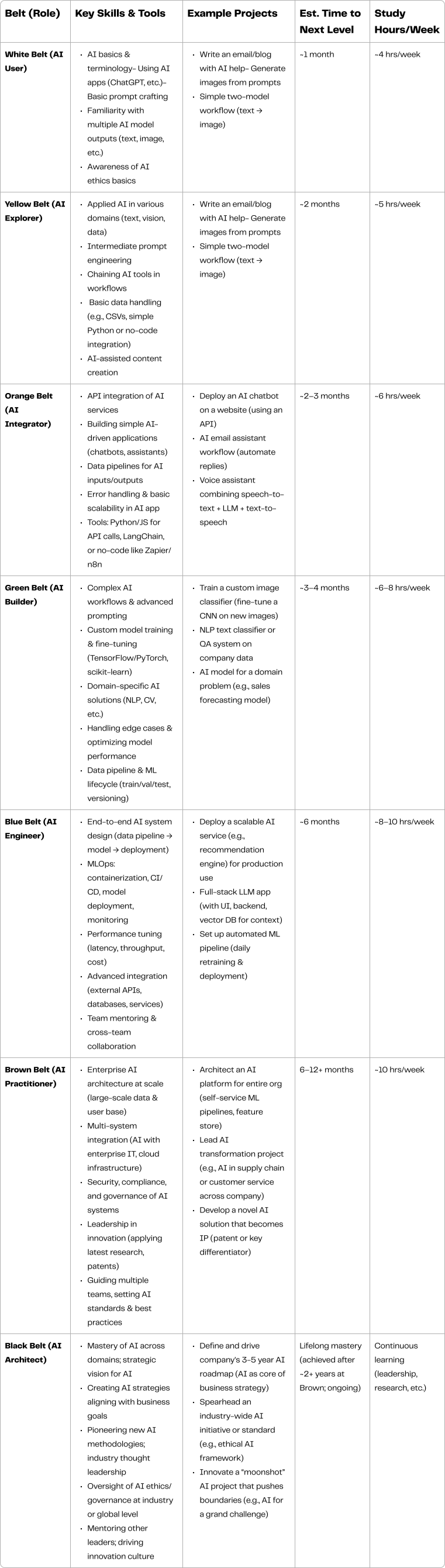
Now that we've detailed each belt in the AI mastery journey, let's summarize the key points of each level side by side for easy reference.
Comparative Summary Table
To wrap up, here is a consolidated comparison of all belt levels with their core focus, skills/tools, example projects, and time commitment. This serves as a roadmap at a glance:
Conclusion
The journey from White Belt (AI User) to Black Belt (AI Architect) is a transformative one. It takes you from simply using AI tools to eventually mastering AI to the point of designing complex systems and guiding strategy. Each belt level has its own challenges, rewards, and learning focus:
- White Belt is about curiosity and getting hands-on without fear. You learn that AI can amplify your abilities – writing, brainstorming, creating – and you establish a foundation of understanding.
- Yellow Belt encourages you to dive deeper and experiment across various AI applications. You start solving real problems with a combination of AI tools and learn how to integrate AI into daily tasks.
- Orange Belt is a turning point where you go from playing with AI to building useful solutions. Integration skills unlock the ability to put AI into products and processes. It’s often where theoretical knowledge meets practical implementation challenges.
- Green Belt solidifies you as a practitioner who can create custom AI models. It’s empowering – you’re no longer limited to off-the-shelf tools, you can make your own. It’s also when many realize the importance of good data and solid engineering around the models.
- Blue Belt elevates you to an engineering leader. The systems you build are robust and scalable; you think about maintainability, performance, and how to work with others to deploy AI broadly. You also start to mentor others, amplifying your impact.
- Brown Belt marks the step into organizational leadership and innovation. You’re solving not just technical problems, but also aligning AI with business strategy, ensuring ethical use, and likely breaking new ground with novel solutions. Your perspective is holistic: people, process, technology, and strategy all come together.
- Black Belt is the zenith – but also a new beginning of mastery. As an AI Architect, you shape the direction of AI initiatives on a large scale. You carry the responsibility to use AI wisely and effectively, and to guide the next generation. It’s a role as much about vision and guidance as about technical know-how. And it’s a stage where learning never stops; you may be a “master”, but you continuously learn from peers, research, and the evolving world.
Throughout this journey, one thing remains constant: the need to keep learning and adapting. The AI field moves rapidly. By the time you reach a new belt, there may be entirely new tools or paradigms emerging (for example, many who started at White Belt with rule-based AI had to learn machine learning at Yellow, deep learning at Green, and so on). This is where Propagated.ai can be your ally at every step - by delivering updates on the recent news, trends and breakthroughs in the industry, it ensures you are never learning in a vacuum.
With a clear roadmap, supportive resources, and a community like Propagated.ai to support your learning path, you have what you need to navigate the journey. Whether your aim is to become a distinguished AI Architect or simply to leverage AI effectively in your current role, the belt pathway guides you step by step. Choose your belt level, set your learning goals, and enjoy the process of continuous growth. AI mastery is not reserved for prodigies or PhDs – with dedication and the right guidance, anyone can progress from white to black belt, turning from an AI user into an AI innovator. The next move is yours – see you on the journey to AI Black Belt!
The Propagated.ai team consists of UX designers, AI researchers, and product strategists dedicated to helping companies create exceptional digital experiences through the power of artificial intelligence and user-centered design.